
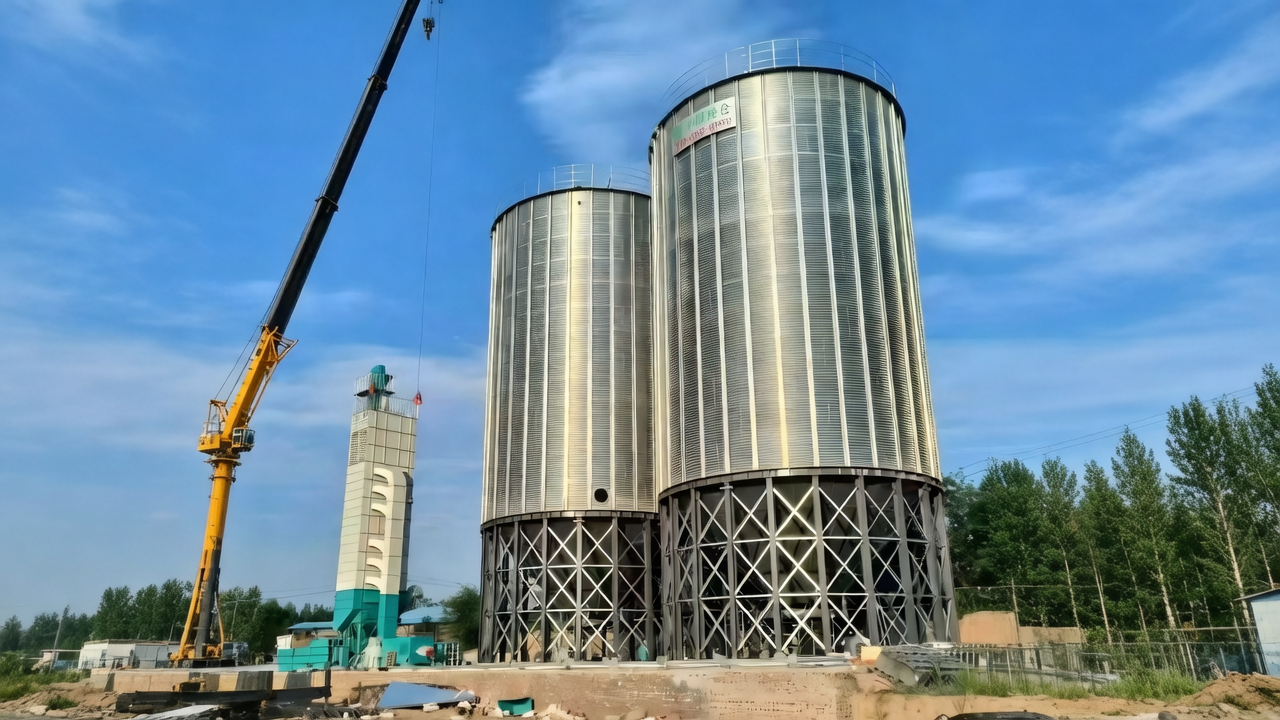
Flat-Bottomed Grain Silo
Flat-bottomed grain silos are large-capacity storage facilities built with hot-dip galvanized steel plates or reinforced concrete. They offer advantages such as large storage capacity, low cost, good sealing, and ease of automated management, making them suitable for long-term static grain storage. However, because the silo floor is flat, a silo cleaning machine is required to assist in emptying the silo, preventing complete gravity-flow discharge.
Inquire This ProductProduct Details
Flat-bottomed grain silos are large-scale storage facilities assembled from high-quality hot-dip galvanized steel sheets. Due to their enormous capacity, economical cost, and excellent sealing, they are widely used in national grain reserves, grain trading companies, and various processing plants for long-term raw material storage. Their basic structure mainly consists of three parts: a ring-shaped silo cylinder, an arched roof, and a horizontal concrete floor.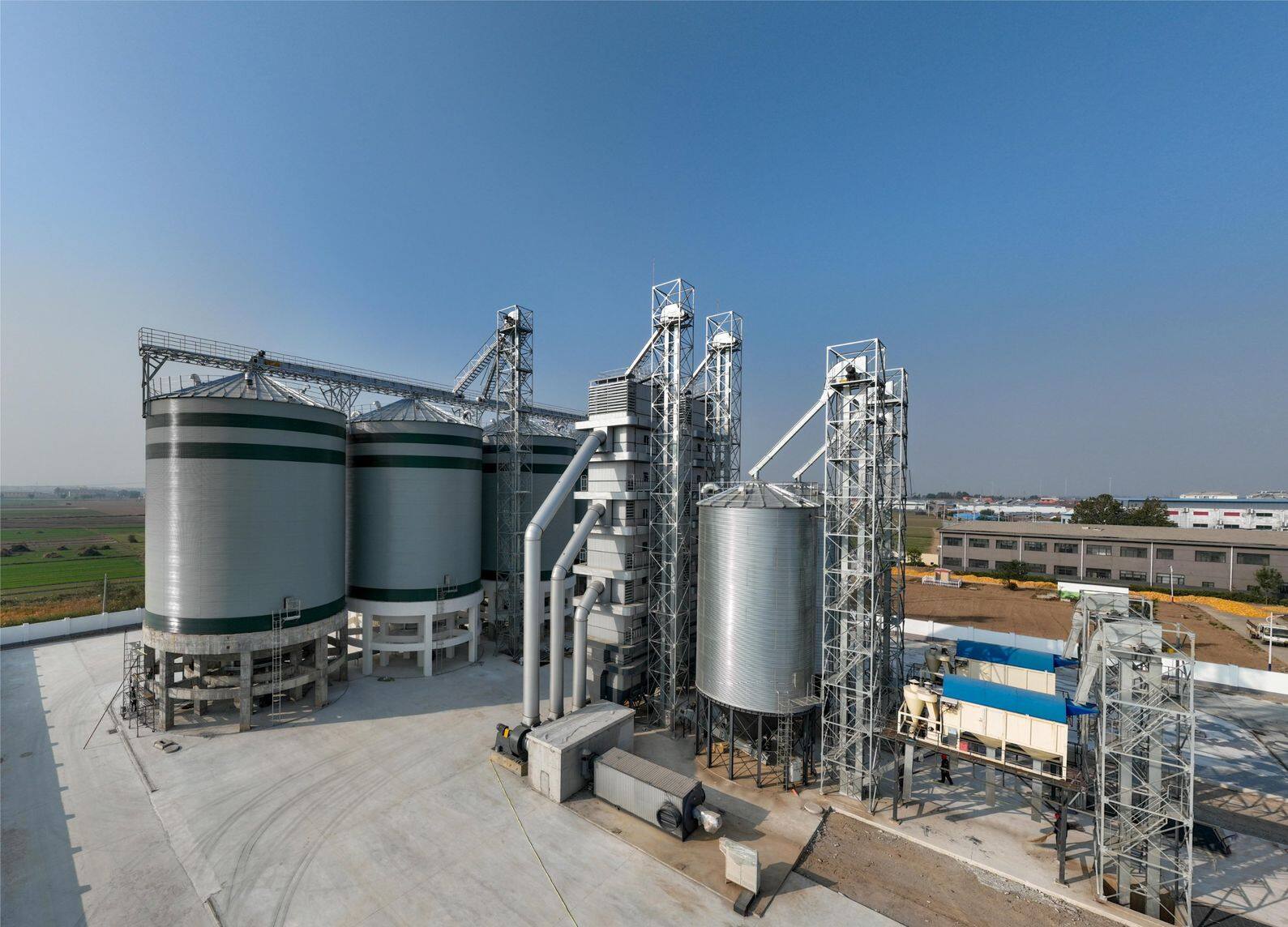
In terms of structural and material details: the silo walls are made of high-strength hot-dip galvanized corrugated steel sheets (such as S350 GD material, with a zinc coating reaching Z275 or Z600 grade), connected by high-strength bolts, providing excellent corrosion resistance and lateral pressure resistance. Externally, they are typically reinforced with Z-shaped steel columns to enhance seismic resistance and load-bearing capacity; the roof uses a space truss structure to withstand snow loads and equipment loads. In addition, the silo is standardly equipped with auxiliary facilities such as maintenance manholes, internal and external ladders, and natural ventilation windows.
In terms of function and application, flat-bottomed grain silos are often equipped with full-floor ventilation systems, circulating fumigation devices, and intelligent temperature monitoring systems. They deliver air evenly through bottom ducts, and sensors enable dynamic monitoring and automatic control of the grain pile's temperature and humidity, ensuring long-term grain storage safety. Single-silo volumes range from 1,000 to 20,000 tons. For large grain silos with diameters exceeding 30 meters, the large capacity brings significant economic benefits—lower unit storage costs, approximately 35%-50% of those of similarly sized reinforced concrete grain silos.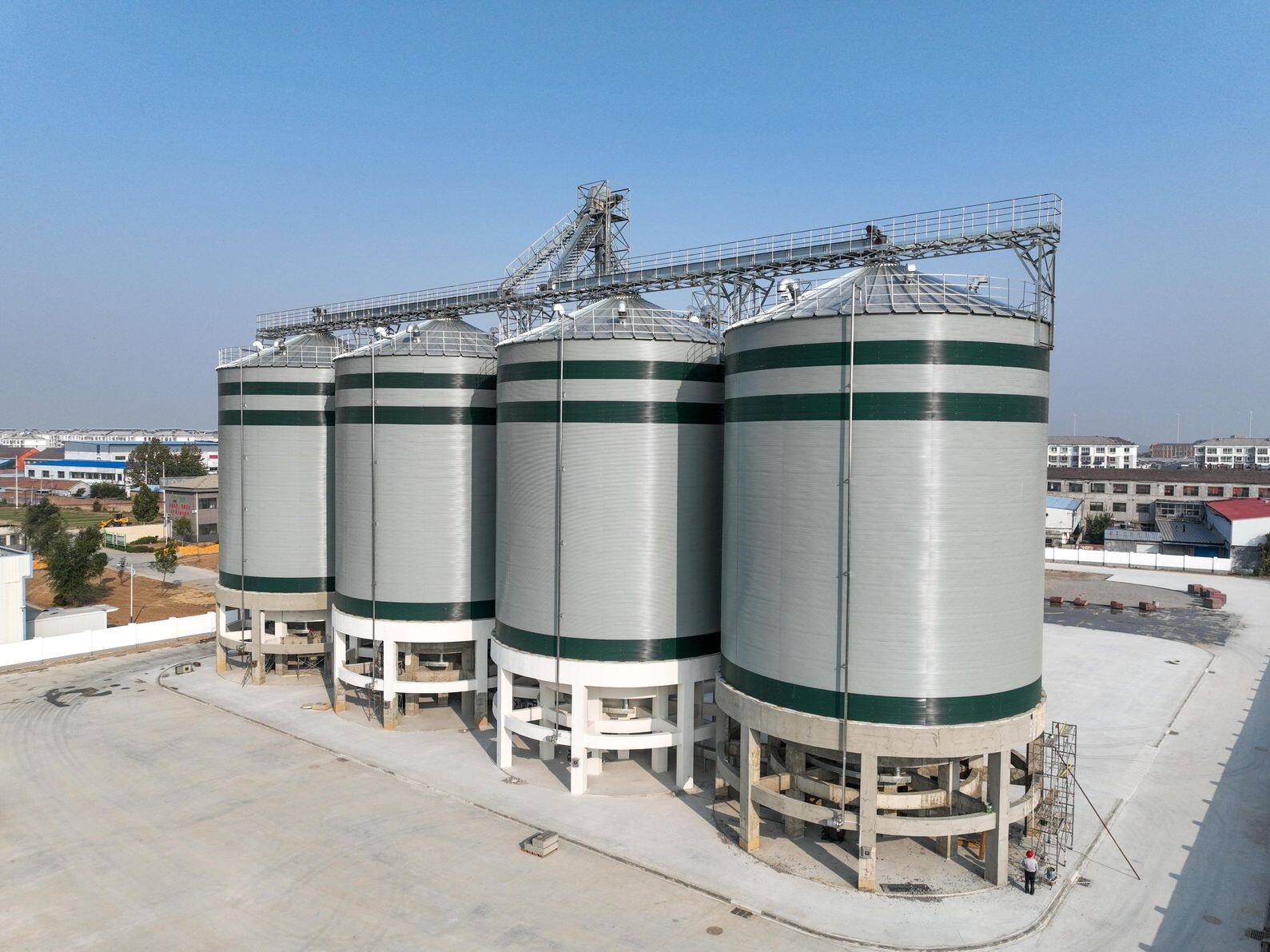
Of course, their operational characteristics also determine their applicable scenarios. Due to the horizontal design of the silo bottom, grain cannot be completely discharged by gravity. After gravity unloading, mechanical equipment such as sweeping machines or spiral cleaning machines are usually required to assist in thorough cleaning. Therefore, they are more suitable for long-term static storage and low-turnover scenarios. For feed mills, trading companies, and other projects requiring rapid, high-frequency turnover, conical-bottomed silos may be more suitable.
Most Popular Flat Bottom Steel Silo Technical Specifications | ||||||||
Capacity | 1000Ton | 1500Ton | 2000Ton | 2500Ton | 3000Ton | 5000Ton | 8000Ton | 10000Ton |
Model | TCK 10014 | TCK 11915 | TCK 13715 | TCK 15514 | TCK 15518 | TCK 18321 | TCK 24718 | TCK 25621 |
Diameter(m) | 10.084 | 11.918 | 13.75 | 15.584 | 15.584 | 18.334 | 24.751 | 25.668 |
Total Height(m) | 18.69 | 20.34 | 20.87 | 20.3 | 24.78 | 28.6 | 26.99 | 30.6 |
Volume(m³) Density: 0.75ton/m³ | 1335 | 2009 | 2701 | 2467 | 4145 | 6693 | 10879 | 13484 |